
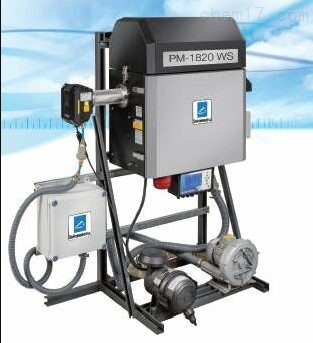
On-line continuous monitoring system (highly low concentration) of PM-1820WS
• Pneumatic and industrial process measurements applicable to the installation of wet scrubbers and below-premature locations
• The entire system includes extraction and pre-treatment systems, as well as laser pre-scatter dusters
• The system has automatic controls and all key components have test features
• A corrosive flue gas application of less than acid dots is optional for corrosion resistant components
• The entire system is free of moving parts and radioactive sources
• Waiting for the smoke to be pumped so that it can actually reflect the actual work of the pipe
System Introduction
PM-1820WS applies to the measurement of particulate emissions from the installation of wet scrubbers and other work conditions below the spot (cool smoker condition) or with droplets. The extraction system extracts typical flue gases from the flue pipe continuously, heats the drops evaporate above the temperature of the condensation point, and then measures the concentration of particulate matter under dry fume conditions.
The PM-1820WS system used heat extraction methods to effectively cater for the effects of in situ monitoring of water and drip interference, and to effectively overcome the difficulties of calibration dilution and data error in dilution techniques.
PM-1820WS uses advanced laser dispersive sensor technology, which has been certified by the German TUV, and by the British MCERTS and meets the European QAL1 standard.
The system is particularly appropriate for monitoring the concentration of particles of wet flue gas following the wet devulcanization device (FGD) of the power plant and the wet flue gas removed from the slurry paper, metallurgical and chemical industries, where particles are of high concentrations and instrumentation is required to prevent their adhesion to the instrument.
Principles of work
The PM-1820WS system extracts continuous smoke from the flue under controlled conditions and evaporates directly to the heating carburetor chamber, at a temperature higher than the point of condensation. In the carburetor chamber, both the flue gas and water are thrown into the outer walls of the heater separator, maximizing the area of exposure and the heating rate. This design has made the PM-1820WS more compact and efficient than the system using the heated sampler line and the dilution system.
The pneumatic gas measured will be delivered into the pipe by the same opening of the sample pipe.
Laser dispersors certified through TUV for key components of PM-1820WS.
PM-1820WS has a strong graphical interface (supported by the Chinese interface) that allows for automatic control and real-time monitoring of light-scatter sensors, heating systems and sampling flows.
Easy to maintain
After proper commissioning and regular maintenance as required, the PM-1820WS system allows accurate and reliable measurements of the concentration of pneumatic particles in the harsh wet flue environment. For all extraction measurement systems (including PM-1820WS), the frequency of regular maintenance and cleaning depends on the specifics of the flue stream. User operators need to be trained by ESA service teams prior to induction, which not only provide user-to-user training services, but also enter into service contracts with users to provide other in-depth on-site services.
Internal quality control system
Instrument design is simple and operational, and external calibration can be easily performed using reference substances.
Sampling flows and heaters are continuously monitored during the operation of the system to detect and avoid congestion or inadequate heating of sampling lines. When the slotting measurement data are valid, the system is shown automatically, thus avoiding the occurrence of a systematic display of invalid measurements during residual heat processes.
The central control unit records all important measurements for future problem diagnosis.
The built-in self-diagnostic function monitors the parameters of the system as a whole to ensure that the system is functioning steadily.
Technical characteristics:
PM-1820WS has the following advantages:
• High sensitivity (<0.1 mg/m3), long-lasting leather, especially for measurements of particulate concentrations of wet flue gas
:: All key components have automatic control and corresponding testing functions (including carburetorization rooms, light-scatter units and sampling pumps)
• Automatic zero point and cross-dispatch screening, and manual calibration
:: A strong user interface, built-in data logs and data records
• Internal system self-diagnosis
• Modularized design to facilitate installation
• Waiting for quick sampling, real response
• Support for the Chinese interface
Process and application conditions
This instrument applies to the following smokeworks:
Measurement range :0-150mg/m3
Minimum test limit :<0.1 mg/m3
Highest flue temperature :100℃
Flue gas: below dew point (wet flue)
Flow speed range: 1-30 m/s
Application of typical wet flue:
It's very good for a wet scrubber.
Corrosive flue gas applications (e.g. wet flue gas desulphurization) require the selection of an enhanced corrosion resistant component
Waste incineration plants using wet and wet ESPs (WESPs)
Recycled boilers in the pulp and paper industry
Metallurgy and chemical industries using wet scrubbers
lime kilns using wet scrubbers
Selection and accessories:
· When the concentration is high 100,000ppm external diluting system
Air scrubbers of internal and combustion gases
External air compressors/generators
Extensionable memory
Temperature-modified piping lines with SS2 μm built-in filters (up to 5 m)
• ESTEL circuit boards (1 or 2)
- 4 independent analog inputs
- 4 independent analog outputs
-4 remote control inputs
- 6 dry-contact outputs
:: Sorel circuit boards (1 or 2)
- 4 dry-contact outputs
- 4 dry-contact inputs
No special version of the LCD screen for integration in engine gas detection cabinets