
Summary:Optimizing the original system on the basis of ARM control, in response to the low accuracy and real-time data collection problems of the on-line monitoring system for flue gas desulphurization in power plants. Design the overall online monitoring system programme in accordance with the requirements of the plant's flue-gas desulphurization system and based on the programme's presentation of two aspects of hardware, software, key hardware selection, critical circuit design, C software design and platform design. Optimized on-line pneumatic desulphurization monitoring systems are applied to a plant and sensor data, switches are statistically and analytically analysed. The results of the practical application showed that the optimized programme performed well in terms of data accuracy, real-time accuracy and was able to ensure the safe, stable and continuous operation of the FGD online monitoring system.
The flue gas released from coal-fired plants became the main source of atmospheric sulfur dioxide emissions, and flue gas desulfurization facilities were installed in the plants to protect the ecological environment. The establishment of an on-line monitoring system for flue gas desulphurization in power plants has become an urgent problem in order to fully perform the installed flue gas desulphurization units and meet emission standards. The Frozen Gas Online Monitoring System (CEMS), known as CEMS, provides real-time access to information on the operational status of the plant's devulcanization plant, its devulcanization efficiency, and its sulfur dioxide concentration, and a number of studies have been carried out by national and international experts and academics on CEMS. In response to the question of the reliability and effectiveness of continuous emission monitoring systems equipped with a 4x600 MW fume-gas desulphurization system in power plants, Pang Haiyu and others proposed an optimisation programme based on S7-200 PLC control, with a focus on increasing the calculation of the concentration of pollutants, increasing the analyzer ' s automatic switch in size, increasing the system ' s inverting and timing data maintenance, increasing the fumes, flow, fumes moisture automatic switching and power-based surveillance signals; (a) The problem of collecting only pneumatic data for the actual operation of CEMS at a fire power plant, the inability to record data on desulphurization devices and their inability to operate in a continuous and stable manner, and the construction of a fully functional and stable CEMS, which is discussed in five areas, on the basis of an analytical monitoring system framework, from structural design, operational monitoring of equipment, equipment control implementation, system interface and remote control realization, and back-office monitoring, respectively; Focused on the selection of relatively stable pneumatic points in the devulcanized flue gas online monitoring system, such as Yin Xiaohong, based on the use of a transected grid to measure and screen the selected points and obtain a relatively stable pneumatic flow point to reflect SO in real terms 2 Emissions; steel bearings, etc., are aimed at achieving standards for emissions of flue gas from the devulcanization plant, energy-saving emission reductions, monitoring of CEMS in operation, practical problems identified, such as low-quality limestone devulcanization parameters control, SO 2 Quality concentration data revision, pneumatic gas velocity field coefficient revision and GGH leakage leading to reduced devulcanization efficiency are combed and analysed, and targeted solutions are proposed to continuously improve and optimize the devulcanization plant. This paper optimizes the original CEMS of a power plant to address the lack of accuracy and real-time in collecting data.
The ARM9S3C2240 industrial processor is at the core of an on-line monitoring system for desulphurized flue gases in a power plant, with the overall structure shown in figure 1.
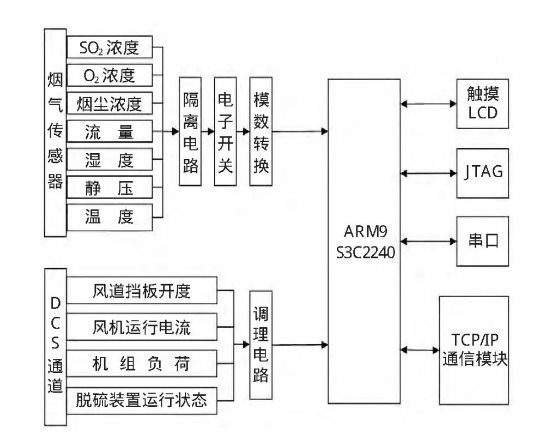
Figure 1 Overall structure of an on-line monitoring system for desulphurized flue gas in a power plant
The system was designed and installed for real-time continuous monitoring of flue gas desulphurization data 2 Concentration, O 2 Concentrations, soot concentrations, flow, humidity, static pressure and temperature sensors, data collected by sensors for transmission by voltage or current signals. In order to ensure the quality and real-time properties of signal transmissions, the ARM9 S3C2240 processors are processed through isolation circuits, electronic switches and modular conversions. The ARM9 processor will receive and logically process sensor data and transmit them in TCP/IP communication mode to the online monitoring system platform for display. Also included in the overall design are wind block openings for the DCS channel, currents for wind engine operation, crew loads, and the operational status of the desulphurization device, which are transmitted via the modulated circuit to the ARM9 processor. LCD touch screens, JTAG circuits, serial communications, etc. have also been designed to facilitate the development and commissioning of online monitoring systems.
2.1 Hardware selection
The central processor selected the S3C2240 industrial processor embedded in the Linux operating system, which consisted of ARM9TDMI, MMU and three components of the high-speed cache. This processor has a power supply level of 1.2 nuclear power in V, 3.3 V storage power, 3.3 V external I/O power supply; It is equipped with three RARTs, two SPIs, one multi-master I2Cs and one I2S communications bus; Up to 130 universal I/O mouths and reusable; 60 sources of interruption; 8. Multi-routing ADC; A combination of standards, hibernation, slow speed and power outage mode. The S3C2240 processor meets the design requirements for an on-line monitoring system for the power plant desulphurized flue gas. Of which, SO 2 Sensor selects EZT3SF Ci Tice L-set electrolyte chemical gas sensor, CITYTECCH, monitoring range (0 to 2,000) x 10 -6 The output signal is a 2-line 4-20 m A current signal with 1 x 10 detection accuracy. -6 Max. Zero Float < 5 x 10 -6 , response time <30 s;O 2 The sensor selects an TY-MZ-type oxygen transporter with an output current accuracy of 0.001 m A with reliability, stability, high accuracy and intelligence, which can be contained within 1% of detection errors; The fume sensor selects the HS-200 online fume gas dust detector to measure the particulate contaminants in the flue stream in real time using the laser backscatter principle, with a sensitivity of 2 mg/m 3 , with measurement error within 2% and temperature resistance up to 300°C, transmitting flue gas data to the central processor via a 4–20 mA current signal. An EPI9000 flow sensor measures flue gas mass flow, with a turndown ratio of 100:1 and either a 0–5 V DC or 4–20 mA output.
2.2 Critical circuits
The plant desulphurized flue gas on-line monitoring system has more sensors available, producing mostly analogue voltage or current signals, which are subject to conversion through A/D before entering the ARM9 processor, using 5 V voltage as the baseline source, using the AD586 chip. The chip has advantages such as high accuracy, low noise and ease of adjusting output signals, and has a maximum resistance of 10 k to R6. A/D conversion circuits are shown in figure 2.
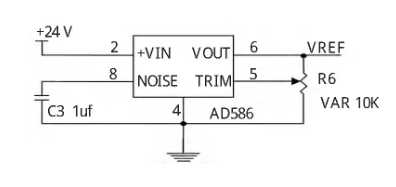
Figure 2 A/D conversion circuits (5 V base source)
During the devulcanization process, real-time monitoring of the wind engine's operational state, the operational load of the devulcanization unit, the crew load and the opening of the windway is required. The above-mentioned signals are from the DCS channel, which has a contact voltage of 12-24 V, which requires a levelling match before entering the ARM9 S3C2240 processor, where the output is pulled from the 74LV245 tri-state bus converter to 3.3 V, which isolates broken voltage and noise, and completes the logical level conversion. 74 LV245 tri-state bus converter four-channel switches collect the adjustable circuits as shown in figure 3.
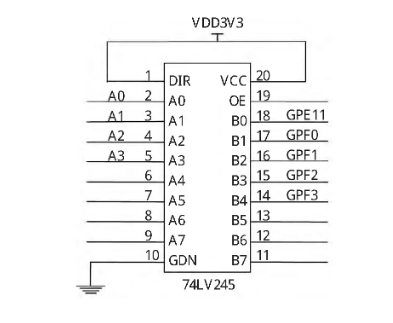
Figure 3 Collecting and adjusting circuits for the fourth-channel switches
3.1 Logical process program design
The plant's devulcanized flue gas online monitoring system logical processing process is based on the Keil software platform and is achieved using the C-language programming, the software framework of which is shown in figure 4.
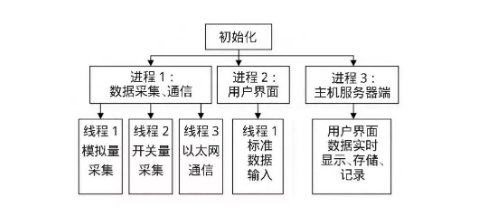
Figure 4 Logical process framework
To ensure real-time monitoring of data transmission, this is achieved using multi-process multi-wire programming. Process 1 completes the sensor data acquisition and communication function, under which line 1 is opened for the collection of simulations, line 2 for the collection of switches, and line 3 for TCP/IP communications; (a) Start-up process 2 completes the design of the user interface, with standard input data processed and mapped at the opening of line 1 under process 2; Launching process 3 completes online monitoring system mainframe server-end functionality, such as real-time display, storage and recording of user interface data.
3.2 Monitoring system platform design
The power plant desulphurized flue gas online monitoring system platform is based on 8.89 cm of TFT Touched LCD monitors for data transmission in TCP/IP communication mode. The monitoring system platform is designed with the main interface, the parameter setting interface, the malfunctioning information interface, the historical curve interface and the trend curve interface, where the SO can be displayed and set up 2 Information on sensors such as concentrations, concentrations of soot, temperature, flow, static pressure, humidity, etc., can also be shown on wind block openings, crew loads, operational status of desulphurization devices, etc. In each interface, there are two “return” and “confirm” buttons to achieve a seamless transition between the interfaces. The online monitoring system parameter equipment interface is shown in figure 5.
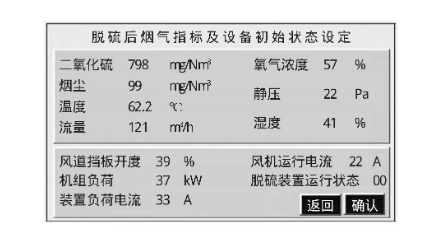
Figure 5 On-line monitoring system parameters interface for power plant desulphurized flue gas
4.1 Data analysis
In order to verify the performance of an online monitoring system for desulphurized flue gas at a power plant, SO at the statistical entry and export point in the pilot operation 2 Concentration, O 2 Data on concentrations, soot concentrations, flue flow, humidity, static pressure and temperature are actually compared as shown in table 1.
Table 1 Comparison of plant flue gas desulphurization data
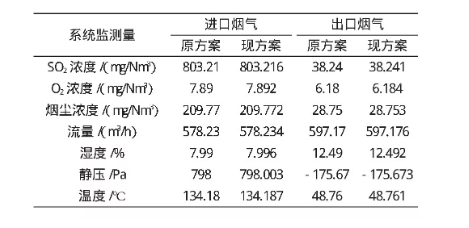
As can be seen from the analysis in table 1, with the current design options, the monitoring levels of the system are more accurate, reaching three decimal places, while meeting the real-time requirements of the system.
4.2 Operation and maintenance
Non-stop monitoring of flue gas treatment volume and SO in the original flue gas at the time of operation of the on-line monitoring system for flue gas desulphurization at the power plant designed and implemented 2 Concentrations, devulcanization efficiency etc., the flue gas desulphurization system was found to be operating with the following problems: (1) the desulphurizer is of poor quality and in no detail meets the criteria; (2) A poor control pH accuracy of the absorbent pulp fluid; (3) Poor control accuracy of the absorption of plume fluids; (4) The pressure control of the desulphurizer rotor is unreasonable. The main method of system maintenance in response to the above-mentioned problems identified during the operation of the system is to control the particle size of the desulphur at around 62 um, with a pass rate of 92 per cent and an increase in the purity of the desulphur from 75.82 per cent to 86.53 per cent, according to the real-time operation of the flue gas desulphurization system of the power plant; (b) The concentration of pH for the absorption of pulp fluid was adjusted from 5.2 to 5.8 to 4.8 to 5.0; Adjustment of the formula for absorbing plume fluid density to increase the filter processing of software, as well as correction of flue gas velocity field practices and leak rates of the GGH flue gas heater to ensure flue gas devulcanization efficiency.
Based on the ARM controller, the prototype on-line monitoring system for flue gas desulphurization at the power plant was optimized and successfully tested, and the accuracy of the sensor data collected was raised to three decimal places; The use of TCP/IP communications ensures the real-time nature of data transmission; An online monitoring system with multiple interfaces based on the LCD touch screen has been designed to show that data, parameters, malfunctioning information have been refined to enable CEMS to have accurate and timely access to the operational status of the plant's flue gas desulphurization system and to ensure its safe, efficient and orderly operation.