
The dust instrument, through the extraction of gas pumps, provides for the detection of aerosol inhalation detection modules, and for the detection of aerosol disposal streams in branches, which are partially filtered into clean air through an efficient filter as a means of protecting the elemental elements of the sensor room from the gas to be detected. Another part of the aerosol enters the sensor room directly as a sample to be tested. In the sensor room, the main element instruments are laser diodes, lenses and photovoltaic detectors. At the time of testing, lasers from the laser diodes first formed a thin-layered light source through lenses. Tight light exposure produces dispersion when the aerosol is to be detected through the sensor room, and detection of the light ' s dispersive light strength is done through a PV detector. PV detectors produce telecommunications signals after they are luminescence, which is comparable to the mass concentration of aerosols. It is then multiplied by a voltage calibration factor, which is obtained by measuring aerosol at a given concentration. The type of aerosol that is commonly used to test aerosols is the dust from the Arizona test (or the ISO 12103-1, A1 test dust).
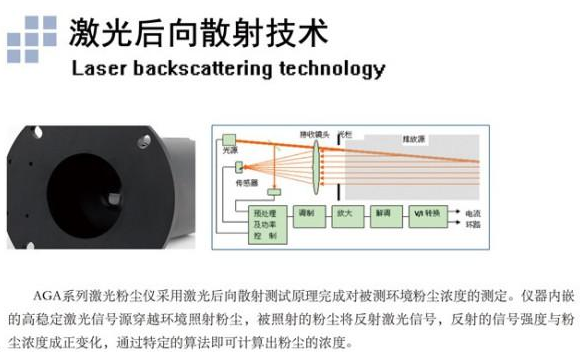
Radio-transmittance sensors.
Exchange electrostatic technology to monitor the standard deviation of the charge signal to determine the amount of disturbance of the communication signal and determine the amount of dust emissions by the size of the instant disturbance amount.
Shanghai-Shanghai Testing Technology Ltd. is primarily involved in the design, production and testing of various environmental detection instruments. The company introduced international advanced testing techniques and worked with the National Testing Centre in China, Shanghai University and the Korean National Institute for Standardization to develop and produce a series of environmental testing instruments. Product performance has reached the internationally advanced level of comparable products, and a greater number of high-tech products fill domestic gaps. At the same time, in cooperation with the Shanghai Institute of Measurement and Testing Technology, the company also provides testing and calibration services for various measuring instruments.
The company's technological strength and the involvement of leading producers and researchers in the drafting of our national standard, the “Methodologies for testing the performance of dust particle counters”, was the lead author in the drafting unit. For a small number of industries in the country with a research and development background in cooperation with major international groups and companies. At the same time, the company is engaged in extensive international cooperation and is working with Modern Group of Korea Correction Technology Ltd. ** on products and technologies, with a view to continuously improving the technological level of products and opening up international markets.