


|
CEMS for the Iron and Steel Industry
In recent years, with the introduction of extremely low-emission technologies in our electricity sector, China ' s focus on air pollution control has shifted from the electricity sector to the non-power sector, where the steel sector is the main focus for reducing emissions. In 2018, China ' s crude steel production stood at 928 million t, the highest in the world, accounting for 51.32 per cent of total global production. China ' s steel production is dominated by long-process processes, including sintering, ball formations, corrosion, furnaces, conversion furnaces and rolling steel. Higher energy consumption leads to significant pollutant emissions. The industry as a whole is characterized by a large number of production processes, a mixed variety of pollutants and a large volume of emissions. In 2017, SO2, NOx and dust emissions in the national steel industry were 32.24 million t, 2.14 million t and 1.209 million t, respectively, the top three sources of industrial emissions. Therefore, the upgrading of environmentally sound technologies in the steel industry is important for improving ambient air quality and winning the Blue Sky War.
Characteristics and challenges of devulcanization in the steel industry The steel industry, as a high-volume, energy-intensive, high-emission industry, is more mature in its devulcanization technology, while the most widely and technologically mature is wet devulcanization. The wet flue gas desulphurization (WFGD) technique, which uses liquid alkaline absorbents to wash the flue gas away from sulfur dioxide, is characterized by the process of desulphurization in the solution, which is wet for both desulphurizers and desulphurization products, and most steel plants are now equipped with or are in the process of implementing additional fumes defiring systems.
In the course of actual production in steel enterprises, the following problems are present: As the weight of wet devulcanization increases, resulting in high flue moisture, production of condensation water versus SO 2 The absorption is very serious, resulting in a measurement distortion that cannot be measured at all. 2 Concentrations; (a) System production of water into gas chambers, which is prone to gas chamber pollution and erosion, increasing maintenance costs; (b) The smoke in the oven contains large quantities of hydrocarbons, such as methane, and gas analyzers of infrared principles are being heavily disturbed; The use of advanced semi-dry processes of devulcanization and active carbon defibrillation have significantly improved the devulcanization efficiency, SO in flue gas 2/NOX The content is very low and higher requirements are placed on the accuracy and measurement floor of the gas analyzer; (b) Coercion and congestion of equipment due to high humidity and easy crystallization of ammonia salt in the national production of the ammonia denitration process; The iron and steel industry has a large number of boilers and a large number of environmentally friendly flue gas vents, which are maintained in large quantities; there are more than 370 platoons at the Shanghai base alone.
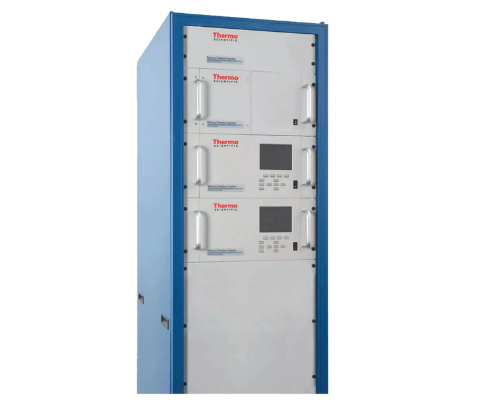
The above-mentioned practical problems in steel industry production affect to varying degrees the devulcanization effects of steel enterprises, affecting not only actual production capacity, but also serious natural damage with massive emissions of sulphides. Therefore, in addition to addressing these issues in a targeted manner, steel enterprises should have a professional, continuous and comprehensive flue gas emission monitoring system. Thermo Scientific™ Continuous monitoring of flue gas emissions
*Thermo ScientificTM Continuous Monitoring System for Frost Emissions The customised Hermo Scientific Tissue TM Fneo gas continuous monitoring system not only meets the requirements of the United States EPA guidelines, but also obtains certification of CCP for Chinese environmental protection products, meets the technical specifications for continuous monitoring of emissions from fixed sources of pollution of the Chinese national environmental protection standards HJ75-2017 and HJ76-2017, and has incomparable sensitivity, accuracy and reliability. Main features:
Four advantages of Thermo Fisher CEMS. Mature dilution measurement techniques that significantly reduce daily maintenance volume and maintenance costs
02 Unique diluted sampling and analytical techniques to ensure accuracy of measurements
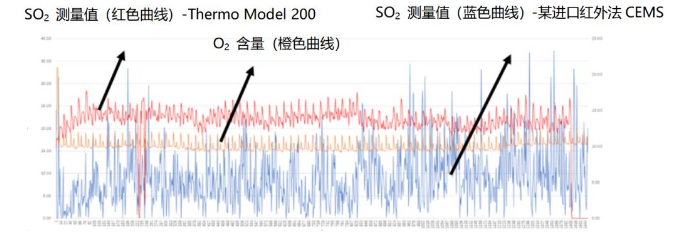
03 Possession of a certified CCPEP for Chinese environmental protection products, which meets the technical specifications for continuous monitoring of emissions from fixed sources of pollution, HJ75-2017 and HJ76-2017 of the national environmental protection standards of China 04 Localized R & D and production to respond quickly to customer needs Actual testing of dilution CEMS
* Comparison of actual test results Test results:
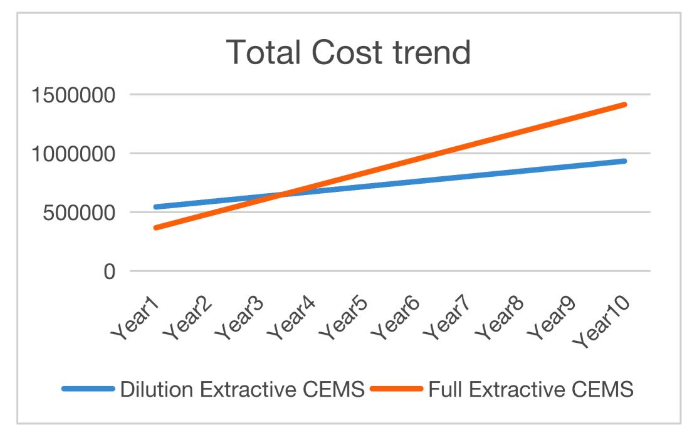
Integrated cost advantage for full life cycle The tests described above confirm the technical advantages of the dilution CEMS, so let's look at the comparison of dilution and direct extraction in terms of combined costs. The cost of dilution was higher than the direct extraction method at the beginning of the project, but over time the dilution showed a clear advantage in terms of material consumption/spare parts replacement/facility maintenance. According to our estimates, the straight-spacing method will exceed and continue to expand over the combined cost in around the fourth year.
The cost of dilution is higher than the cost of direct cutting at the beginning of the project, but over time the dilution has shown a clear advantage in terms of consumption of materials/spare parts/facing maintenance. According to our estimates, direct cutting will exceed the combined cost of dilution in around the fourth year and continue to expand. |